

YOUR AIRCRAFT FIELD GUIDE
THE B-52 STRATOFORTRESS
Huge range. Heavy payload. Generations of flight.
Meet the giant that keeps adapting.
SINCE 1955

- POWERED BY
- 8 engines
Four pairs beneath the wings
- UNREFUELED RANGE
- 8,800+ mi
Over 8,800 miles
- WEAPONS PAYLOAD
- 70,000 lb
Up to 35 U.S. tons
Range and payload figures describe the B-52H. The museum’s aircraft is an earlier B-52D. Maximum payload and maximum range are not necessarily achieved on the same flight.
A GIANT
ACROSS GENERATIONS
Imagine an aircraft that began flying before your grandparents were born—and whose later versions still fly today.
The B-52 first took to the air in 1952 and entered operational service in 1955. It became a major part of America’s long-range bomber force during the Cold War.
In 2025, the Air Force celebrated 70 years of B-52 service. A strong original design and continued modernization have helped this aircraft family keep going for generations.
EIGHT ENGINES.
ONE SKY GIANT.
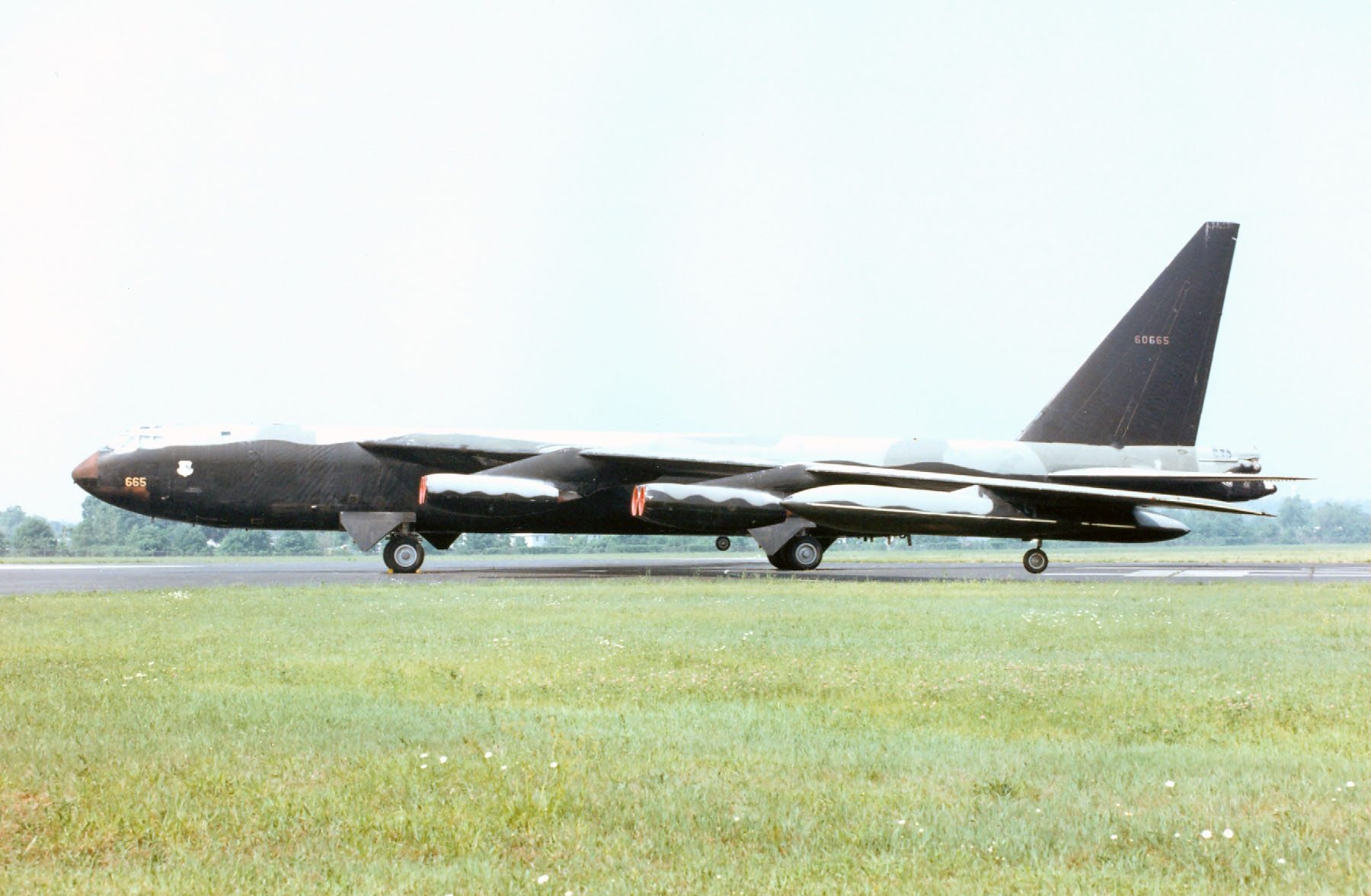
Look beneath the wings: the B-52’s eight jet engines are grouped in four pairs.
Its wings stretch 185 feet from tip to tip. On the museum’s B-52D, that span is greater than the aircraft’s length!
GOING THE
EXTRA THOUSAND MILES
The Air Force lists the B-52H’s unrefueled combat range as more than 8,800 miles. Aerial refueling lets it receive more fuel while flying, extending its reach even farther.
Here’s a real endurance adventure: in 1957, three B-52Bs completed a nonstop flight around the world. They flew for 45 hours and 19 minutes, refueling in the air along the way.
A fuel stop doesn’t always mean a landing.
ROOM FOR A
HEAVY PAYLOAD
A payload is the load an aircraft carries for its mission. The B-52H can carry up to 70,000 pounds of weapons, including bombs and missiles.
This photograph looks into the museum B-52D’s bomb bay: the compartment inside the aircraft used to carry bombs.

OLD DESIGN.
NEW CAPABILITIES.
How does an aircraft keep up as technology changes? Engineers upgrade what it can do.
The B-52’s modernization program includes new radar, replacement engines, and improvements to its communications and other onboard systems. These changes help an old aircraft design handle new demands.
In December 2025, a B-52 fitted with a new radar flew to Edwards Air Force Base for testing. The Air Force plans to keep B-52s serving through 2050, potentially beyond.
Long reach, a large payload, and continued upgrades help explain this giant’s extraordinary career.
Sources & photo credits
Research checked September 8, 2026. Figures are labeled by variant. Future service dates describe Air Force plans, not guarantees.
- U.S. Air Force: B-52H fact sheet — engines, unrefueled range, payload and aerial refueling.
- National Museum of the U.S. Air Force: B-52D fact sheet — dimensions, 1957 world flight and the museum aircraft’s history.
- Air Force Global Strike Command: 70 years of service — first flight, operational service and the reasons for its longevity.
- U.S. Air Force: radar modernization milestone, December 2025 — radar testing, planned upgrades and future service.
All three photographs are explicitly marked public domain in their official records, linked beneath each image. Flight photo: U.S. Air Force / Airman 1st Class Benjamin Cooper, 180409-F-IZ785-0096. Museum aircraft: U.S. Air Force, 071102-F-1234S-004. Bomb bay: U.S. Air Force, 140212-F-IO108-009.
Use of these photographs does not imply U.S. Air Force or Department of Defense endorsement. DoD imagery-use guidance ↗

“Did you know THE B-52 entered service in 1955 and it’s still flying missions for the U.S. Air Force today?”